
If your business feels like it’s running on memory, quick decisions, and constant catch-up, you’re not alone.
Most business owners don’t start with systems. They start with doing everything themselves. And for a while, that works.
Until it doesn’t.
You hit a point where things feel scattered. Tasks take longer than they should. You repeat yourself. You fix the same mistakes. And even when you’re working all day, it still feels like you’re behind.
That’s usually the moment where systems need to come into play.
Not complicated systems. Not corporate processes.
Just simple, clear standard operating procedures that make your business easier to run.
What Are SOPs and Why Do They Matter?
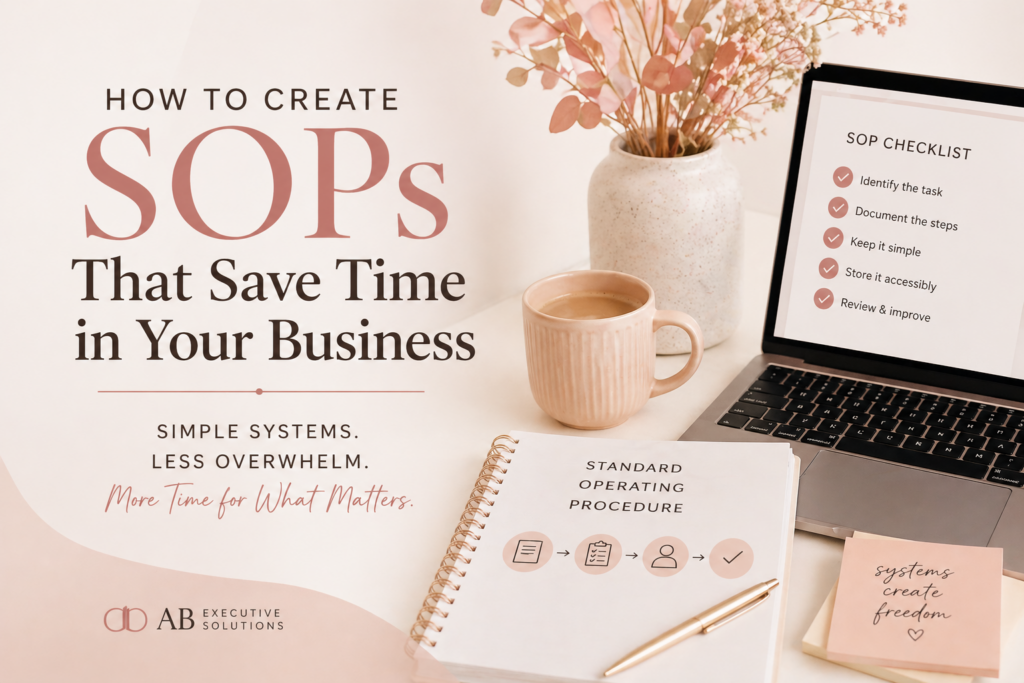
Standard operating procedures, or SOPs, are simply documented steps for how something gets done in your business.
They answer the question:
“How do we do this every time?”
Without SOPs, everything lives in your head.
With SOPs, your business starts to run with consistency.
That means:
- fewer mistakes
- less back-and-forth
- less time spent explaining things
- more confidence when handing work off
SOPs don’t slow you down. They remove friction.
Why Most Business Owners Avoid SOPs
There’s a common assumption that SOPs take too much time to create.
Or that they have to be perfect.
Or that they only matter when you have a large team.
None of that is true.
The real reason most people avoid SOPs is because it feels overwhelming to figure out where to start.
But you don’t need a full system overnight.
You just need one starting point.
Step 1: Start With What You Repeat
Look at your week and ask:
“What do I do over and over again?”
That’s where your first SOP should live.
Examples:
- responding to inquiries
- onboarding new clients
- scheduling meetings
- posting content
- sending invoices
If you’ve done something more than twice, it can become a process.
Step 2: Write It Like You Would Explain It
You don’t need formal language.
Just write the steps the same way you would explain it to someone else.
For example:
Client onboarding might look like:
- Send welcome email
- Share intake form
- Create client folder
- Schedule kickoff call
- Send next steps
That’s it.
Simple. Clear. Usable.
Step 3: Keep It Accessible
Your SOP should live somewhere easy to find and update.
This could be:
- Google Docs
- Notion
- Your project management tool
If it’s hard to access, it won’t get used.
Step 4: Use It Before You Perfect It
This is where most people get stuck.
They try to perfect the process before using it.
Instead, use it as-is.
Then adjust:
- what’s missing
- what’s unclear
- what can be simplified
SOPs improve through use, not planning.
Step 5: Build From There
Once you create one SOP, it becomes easier to create the next.
Over time, you’ll build a small library of processes that support your business.
That’s when things start to feel different.
You stop holding everything in your head.
You stop repeating yourself.
You start operating with clarity.
What Changes When You Have SOPs
When SOPs are in place, your business feels more stable.
You’ll notice:
- tasks get done faster
- fewer questions come back to you
- onboarding becomes smoother
- delegation becomes easier
- your time opens up
This is how you move from reacting all day to actually leading your business.
Where Support Comes In
Building systems doesn’t mean doing it alone.
Sometimes the hardest part is simply organizing what already exists in your head and turning it into something usable.
That’s where the right support makes a difference.
At AB Executive Solutions, we help business owners create simple, effective systems that reduce overwhelm and make day-to-day operations easier to manage.
If you’re starting to feel the weight of doing everything yourself, this might be the next step.
You don’t need a full overhaul. Just a place to begin.
👉 Learn more at www.abexecutivesolutions.com